
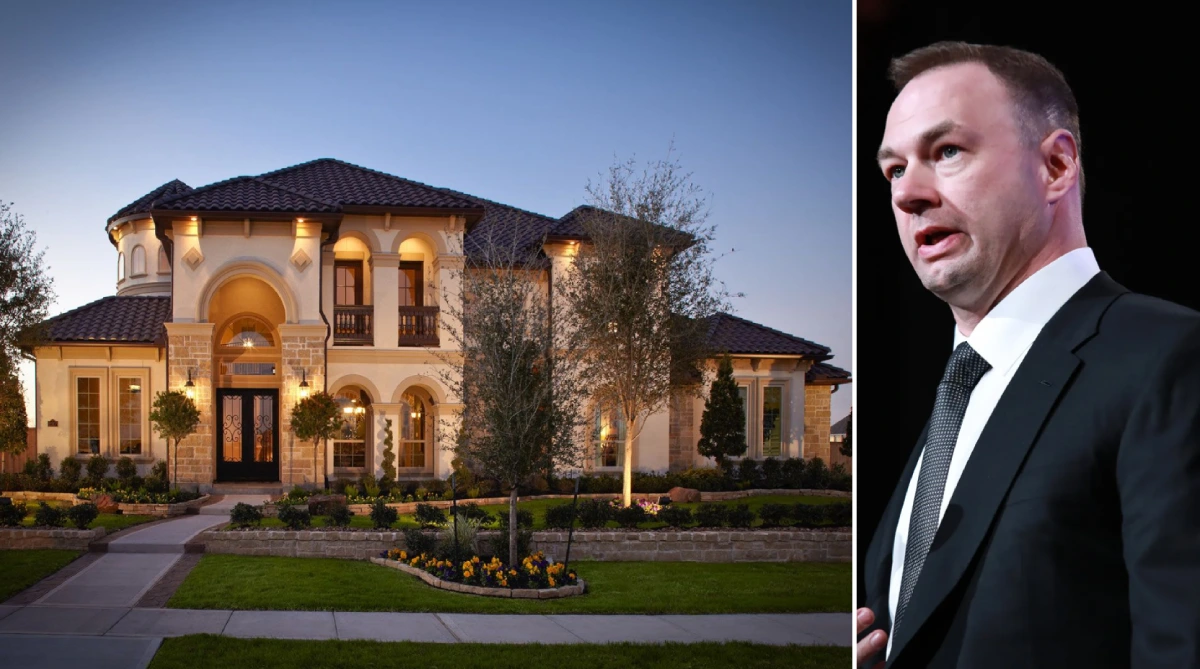
The Thomas Tull House is a 33.34-acre ultra-luxury estate in Westlake Village, California, originally listed at $85 million in 2018 and sold for $35 million in October 2020. Designed as a French chateau with over 50,000 sq ft across seven structures, it features a Dolby-certified private cinema, a 5-acre organic farm, a quarter-acre millpond, and museum-grade oxygen-depleting fire suppression. The $35M closing set a Ventura County residential record and highlights how hyper-personalized estates often face significant price adjustments in the ultra-luxury market.
When billionaire film producer Thomas Tull listed his Westlake Village compound in January 2018 for $85 million, it was widely described as one of the most extraordinary private estates ever built in Southern California. By the time it finally sold — at $35 million — it had quietly set a record as the most expensive single residential property ever sold in Ventura County. This is the full story of the property: how it was built, what makes it unlike anything else in the region, and what its sale tells us about the ultra-luxury real estate market.
Who Is Thomas Tull?
Thomas Tull is a self-made billionaire, best known as the founder and former CEO of Legendary Entertainment, the production company behind some of Hollywood’s highest-grossing films. His executive producer credits include Christopher Nolan’s Dark Knight trilogy, Inception, 300, The Hangover series, Jurassic World, and Interstellar — a body of work that generated billions at the global box office.
In 2016, Tull sold Legendary Entertainment to China’s Dalian Wanda Group for approximately $3.5 billion, one of the largest entertainment acquisitions of that era. After stepping down as CEO roughly a year later, he shifted his focus to technology investment through his holding company, Tulco, which has backed companies including Magic Leap, Oculus Rift, and Pinterest.
Beyond film and technology, Tull is a part-owner of the NFL’s Pittsburgh Steelers and owns Rivendale Farms, a sustainable and organic farming operation near Pittsburgh — a city he has publicly described as home. In 2017, he relocated his family there, later announcing that Pittsburgh would serve as the headquarters for Tulco’s artificial intelligence and machine-learning operations.
House Location and Scale
The estate sits at 3970 Victoria Lane, Westlake Village, California 91362, tucked into the hills of the Conejo Valley roughly 35 miles northwest of Los Angeles. Westlake Village sits at the border of Los Angeles and Ventura County — a quiet, affluent area known for large lots and privacy, and far removed from the density of Beverly Hills or Bel Air.
Tull assembled the compound by purchasing three adjacent parcels near Kanan Road and Westlake Boulevard beginning in 2011, later incorporating a fourth lot. He was able to privatize and gate the cul-de-sac itself, effectively removing the entire street from public access. A fourth adjacent lot was eventually incorporated, bringing the total land to 33.34 acres — a scale rarely seen in residential California real estate.
For context, that’s larger than many private golf courses.
Construction and Architecture
Tull spent several years transforming what had been three separate residential properties into a single, unified estate. The project was spearheaded by architect Brian Biglin of Brian Biglin Architects, who re-engineered the main residence from the foundation up in a classic French château style.
The estate was built to completion by 2013, though Tull continued refining the property for years afterward. Total construction cost has not been publicly disclosed, but the scope of what was built — and the materials used throughout — suggests a figure well into the tens of millions beyond land acquisition costs alone.
Total built space across all structures exceeds 50,255 square feet, spread across seven separate buildings on the 33-acre site.
The Main Residence
The primary house covers approximately 32,000 square feet across three levels. The exterior is stone-clad, consistent with the French chateau aesthetic. Inside, the design carries through with custom millwork, domed ceilings, and rich wood paneling.
Key spaces in the main house include:
- Formal rooms — grand-scale entertaining spaces with ceiling heights and proportions matched to the architecture
- A library — a dedicated, full-scale reading and reference room
- Dual kitchens — a French-inspired chef’s kitchen alongside a separate commercial prep kitchen
- A temperature-controlled wine vault
- A 5,000-square-foot master suite — larger than the average American single-family home, containing two fireplaces (one inside the bathroom), a 2,000-square-foot closet, and a private sitting area
- Two 4,000-square-foot garages
- A Dolby Lab-certified private cinema — 18 seats, a 20-foot by 10-foot screen, 21 speakers, and six subwoofers, delivering studio-quality sound in a residential setting
The master suite alone became one of the most-cited details in media coverage of the property — the closet is roughly the size of a three-bedroom apartment.
The Supporting Structures
The estate is not a single house with a yard. It functions more like a private village, with each structure serving a distinct purpose.
- Guesthouse (11,000 sq ft): The guesthouse is a full residence in its own right. It includes its own infinity pool, a dedicated home theater, and — notably — a guesthouse of its own within it. A self-contained structure that most buyers would consider a primary home.
- Pool House / Spa (2,644 sq ft): The pool house doubles as a spa facility, including a Himalayan salt therapy room, steam room, sauna, and massage room. The swimming pool adjacent to it is described as nearly half the length of a football field.
- Greenhouse (1,500 sq ft): A glass greenhouse supporting the estate’s on-site food production.
- Collector’s Museum (1,869 sq ft): Built specifically to display Tull’s private collection, the museum is equipped with a biometric gas system — a fire suppression mechanism that removes oxygen from the room rather than using water or chemical agents, protecting irreplaceable items from fire damage without destroying them in the process.
- Professional Photo Studio: A full-scale photography studio on the grounds, sized and equipped for professional use.
- Pittsburgh Steelers Sports Lounge: Tull is a partial owner of the NFL franchise, and the estate includes a dedicated Steelers-themed sports lounge — a room that speaks to his personal identity as much as his investment portfolio.
The Grounds
The outdoor spaces are where the estate most clearly distinguishes itself from standard luxury properties, regardless of price point.
- The Monet Garden Inspiration: The formal gardens were designed in direct reference to the gardens of Impressionist painter Claude Monet at Giverny, France. Four cascading pools anchor the garden layout, connected by stone bridges. Hundreds of trees were planted across the property. The result is a European estate garden transplanted into the hills of Southern California.
- The Millpond: A quarter-acre lake sits near the estate’s entrance, complete with an authentic millhouse and water wheel. The pond is stocked with fish — catfish, largemouth bass, and bluegill — and functions as both a visual centerpiece and a working water feature.
- The Organic Farm: A five-acre working farm on the property includes 18 in-ground farm beds and more than 150 fruit trees. Produce grown here supplies the estate directly — a genuine farm-to-table operation at residential scale.
- Two Municipal-Quality Water Wells: The wells supply water independently from the municipal grid, servicing both residential needs and the farm’s irrigation requirements. This level of water independence is unusual even among ultra-luxury estates.
- Solar Energy System: A 275-kilowatt solar installation provides the majority of the estate’s electricity needs — one of the larger private solar systems installed on a residential property at the time of construction.
The Listing and Price History
Tull listed the property in January 2018 at $85 million, positioning it as the most expensive listing in the Conejo Valley by a significant margin — and one of the most expensive residential listings in California at the time.
The asking price reflected the cost of construction and the uniqueness of what had been built. Listing agent Jordan Cohen of Re/Max Olson & Associates, who has represented more than 100 professional athletes over his career, described it as unlike anything he had seen in his career.
The property did not sell quickly. Over the following months, the lack of a buyer at the asking price reflected a consistent dynamic in the ultra-luxury market: properties with highly personalized, owner-specific features often take longer to find the right buyer, and rarely sell close to the original ask.
The Sale: A Record at $35 Million
The estate closed in October 2020 for $35 million — a 58.8% reduction from its original asking price — following a rapid one-week escrow period. Cohen represented the Tull family in the transaction. The buyer was represented by Bryan Bumbarger, also of Re/Max Olson & Associates.
Despite the significant discount from the listing price, the sale set a record: the most expensive single residential property ever sold in Ventura County and the Conejo Valley. The previous record in the area was the $19.2 million Tull himself paid for the main 16-acre parcel in 2011.
For additional context on regional pricing: a property in the Ventura County portion of Malibu sold for $20 million in 2017 — the prior county record.
The buyer remains anonymous, consistent with ultra-high-net-worth transactions that prioritize privacy through LLC purchases and off-market escrow routing.
Why the Gap Between Asking and Sale Price?
The $50 million difference between list and sale price raises an obvious question. Several factors likely contributed:
1. Personalization at scale
A Pittsburgh Steelers lounge, a private film studio, a biometric museum, and a Dolby-certified cinema are genuinely impressive, but they were built for Thomas Tull specifically. A buyer pays to replace or repurpose features they don’t need.
2. Carrying costs
A 33-acre estate of this size requires significant ongoing maintenance, staffing, and operating expenses. Buyers factor this into what they’re willing to pay.
3. Limited buyer pool
At $85 million, the number of qualified buyers globally is small. In Westlake Village specifically, the number is far smaller. The estate competes for a buyer who wants something of this scale outside of traditional luxury markets like Bel Air, Beverly Hills, or Malibu.
4. Market timing
The property was listed and sat through a period of softening at the very top of the luxury market.
The $35 million final price still represents a record for the region, and likely a significant overall investment from Tull’s perspective when land costs, construction, and years of maintenance are accounted for.
By the time the sale closed, Tull had already been living in Pittsburgh for several years. His move there was not just personal — it was a deliberate business decision to build Tulco’s technology operations in a city he described as undervalued and well-positioned for the next wave of tech development.
He has maintained his ownership stake in the Pittsburgh Steelers and continues operating Rivendale Farms. His public profile has been lower since leaving Legendary Entertainment, but his investment activity through Tulco has continued across artificial intelligence, machine learning, and technology sectors.
Conclusion
The Thomas Tull estate in Westlake Village is one of the most fully realized private residential projects ever completed in Southern California. Built over years with specific architectural intent, it combines working infrastructure — organic farming, solar power, independent water supply — with entertainment-grade amenities and museum-quality facilities.
Its sale history also illustrates something real about the ultra-luxury market: a property can be extraordinary and still take years to sell, at a price far below its original ask. The record it set at $35 million says as much about the regional market as it does about the estate itself — a one-of-a-kind property that finally found a buyer willing to take on a very specific kind of legacy.