
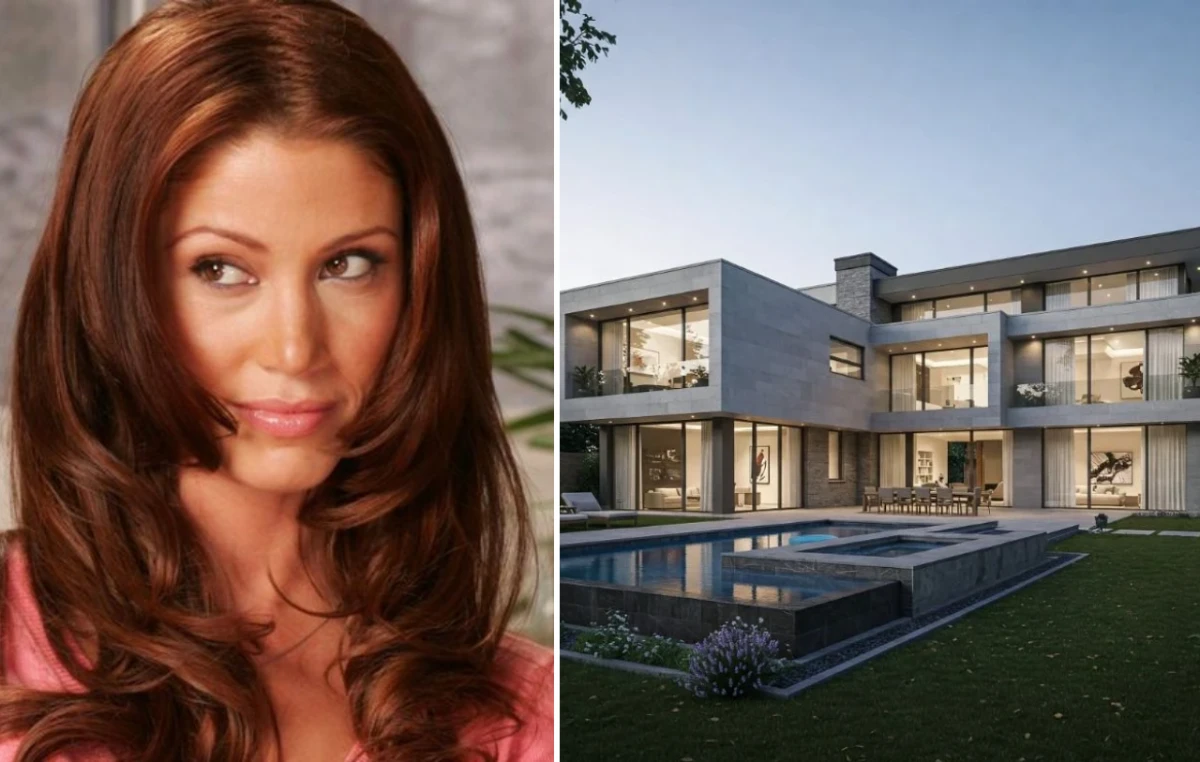
Shannon Elizabeth bought her Los Angeles home in August 2001 for $1.425 million. She sold it in June 2014 for $2.8 million — a near-double in value over 13 years. The same house was later sold again in March 2023 for close to $6 million, which tells you everything about what walking away from that property cost her in hindsight.
Here is the full story of the house, what it looked like, how the sale played out, and where Shannon Elizabeth lives now.
The Los Feliz Home: What She Actually Bought
The property sits in the celebrity-approved Los Feliz area of Los Angeles — a 1920s-era Mediterranean-style residence with three stories and sweeping city views.
The numbers: 4,689 square feet, 5 bedrooms, and 5.5 bathrooms. For a single person, that is a significant amount of space, but Los Feliz properties of this era tend to carry architectural features that justify the square footage — high ceilings, thick walls, layered floor plans built into hillside lots.
Key property features included:
- Street-level three-car garage with a walled and gated entry
- A nearly quarter-acre parcel with generous terraced and landscaped gardens, including several elevated terraces and verandas
- A foliage-covered terrace with an outdoor BBQ and fireplace
- A flat patch of grass — used, reportedly, for her dogs
- Off the lowest level, a multi-level terrace stepping down to an ozone swimming pool with a long view over the shrubbery toward the downtown Los Angeles skyline
The Mediterranean style fits the Los Feliz hillside context well. These 1920s properties were built with heavy stucco exteriors, red-tile rooflines, arched doorways, and interior finishes that age noticeably if not maintained. Whether Shannon updated the interiors during her 13 years of ownership is not documented in public records, though listing notes described the home with sponge-painted walls — a detail that suggests the interior was not dramatically modernized.
The Sale: A Long and Messy Exit
Shannon Elizabeth did not sell this house quickly or cleanly. The process stretched nearly two years.
She first listed the property in August 2012 with an asking price of $2,988,000. The price was changed twice before. In January 2013, the property was delisted and then quickly re-listed at $2,694,000. The price dropped again to $2,676,000 before it was pulled from the market entirely in May 2013.
She re-listened in 2014. She ultimately accepted $2.8 million in June 2014.
While the initial $2.99M ask proved ambitious for 2012 luxury real estate, the eventual $2.8M close delivered a 96.5% sell-to-list ratio by the final listing cycle—a strong outcome for a niche, architecturally specific property during a volatile recovery market. The two-year process cost her time but did not meaningfully affect the outcome.
What the numbers look like:
| Event | Year | Price |
|---|---|---|
| Purchase | 2001 | $1,425,000 |
| First listing | 2012 | $2,988,000 |
| Final accepted offer | 2014 | $2,800,000 |
| Resold by the new owner | 2023 | ~$6,000,000 |
She should have held on to the house, because it sold in March 2023 for nearly $6 million. That is not a small gap. Selling in 2014 and watching the same asset triple in value over the next nine years is a real cost — though she made a deliberate choice about what she was trading it for.
Why She Sold and Where She Went
The sale was not driven by financial pressure. It was a deliberate exit from the Hollywood lifestyle.
In 2015, Shannon Elizabeth officially relocated her primary residence to South Africa, channeling the $2.8M from Shannon Elizabeth’s House into her conservation work. Through the Shannon Elizabeth Foundation and its Animal Haven rescue operations, she now oversees habitat restoration and anti-poaching initiatives across thousands of protected acres.
In 2016, she moved to South Africa. Two years later, the Shannon Elizabeth Foundation was born — dedicated to protecting endangered species, preserving critical habitats, supporting rangers on the frontlines, and building lasting solutions for conservation.
At the heart of this work is the Khusela Endangered Wildlife Sanctuary, created for Munu, a blind black rhino whose story became a symbol of resilience. Spanning 2,300 acres (930 hectares) of protected wilderness, the sanctuary was established to safeguard Africa’s most vulnerable species.
The Los Feliz house and the South Africa sanctuary are not really comparable as “homes.” One is a personal residence; the other is a working conservation operation on a protected land holding. Shannon Elizabeth effectively traded a $2.8 million city house for a life built around a 2,300-acre wildlife refuge. Whether that trade-off was financially wise is beside the point — it was a values decision, made clearly and followed through on.
The Los Feliz Neighborhood Context
Los Feliz is one of the few LA neighborhoods where 1920s architecture has held consistent value and desirability for over a century. It sits directly below Griffith Park, which provides a hard boundary against development and makes the hillside views permanent rather than at risk of being blocked by future construction.
The Griffith Park / Los Feliz housing market is somewhat competitive. Homes sell for about 1% above list price and go pending in around 37 days. Hot homes can sell for about 11% above list price.
The area has long attracted actors, musicians, and film industry professionals who want proximity to Hollywood without living in it. Properties on the hill command premiums for views, privacy, and architectural character that the flats cannot replicate. Shannon Elizabeth’s home — with its gated entry, terraced gardens, pool, and downtown skyline views — was a well-positioned asset in that market.
The near-$6 million resale in 2023 reflects both the general LA price appreciation of that decade and the continued demand for hillside Mediterranean estates in Los Feliz specifically.
What This Property Tells You About Her Career Arc
Shannon Elizabeth bought this house immediately after her American Pie success in 1999. She paid $1.425 million in August 2001 — a purchase that signals she was earning real money and investing it in hard assets rather than spending it on lifestyle overhead.
She held the property for 13 years through a career that slowed down significantly after her early 2000s peak. That she still walked away with nearly $1.4 million in profit — and did not sell under financial duress — suggests she managed her finances carefully.
The story of this house is not really about real estate. It is about someone who used her Hollywood earnings to buy a valuable asset, held it, sold it, and redirected the proceeds toward something she cared about more. The $2.8 million became seed capital for a wildlife conservation effort in South Africa that now covers 2,300 acres and focuses on one of the most critically endangered animals on the planet.
While hindsight highlights a $3.2M valuation gap, the true ROI wasn’t financial—it was impact. Converting liquid real estate into a permanent, 2,300-acre wildlife corridor demonstrates a deliberate pivot from Hollywood accumulation to legacy building.
Conclusion
Shannon Elizabeth’s House was never just a Los Angeles real estate transaction—it was a deliberate pivot point. From a 4,689-square-foot Mediterranean retreat to the financial catalyst for a 2,300-acre wildlife sanctuary, the property’s story proves that true asset value isn’t always measured in resale multiples. Whether you’re tracking celebrity real estate trends, analyzing luxury LA market shifts, or looking to support frontline conservation efforts, the legacy of this Los Feliz estate continues to unfold.