
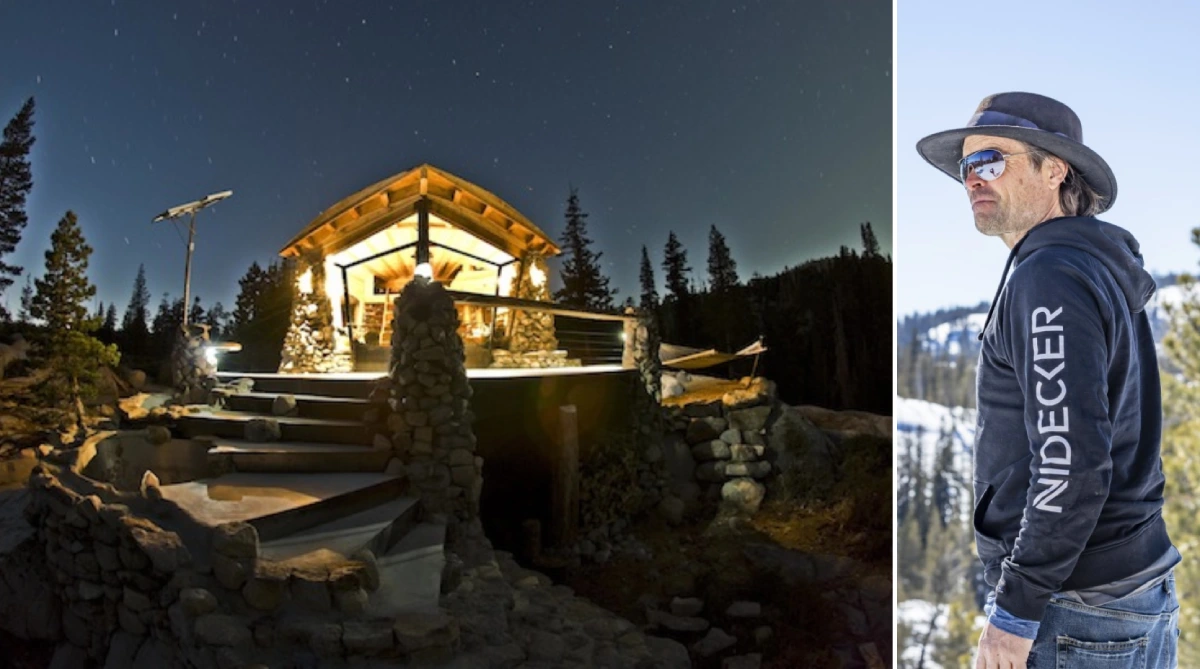
Mike Basich was once pulling $170,000 a year as a professional snowboarder, living in a 4,000-square-foot house in Utah and driving a luxury car. He walked away from all of it. Today, he lives in a hand-built, 228-square-foot stone cabin perched at 7,100 feet in the Sierra Nevada mountains — with no indoor plumbing, no neighbors for miles, and a private chairlift outside his front door.
This is not a story about minimalism as a trend. It’s the story of a man who deliberately built the life he actually wanted, using his own two hands, from the ground up — literally.
Who Is Mike Basich?
Mike Basich grew up in Sacramento, California, and turned professional as a snowboarder in the late 1980s. He competed on the international contest circuit for years, rising to the top tier of the sport. But competition eventually felt like a cage. He quit contests to chase storms, live on the road, and snowboard entirely on his own terms.
When his sponsorships dried up after leaving competitions, Basich pivoted — he became a self-portrait photographer, rigging remote-operated cameras to capture himself riding from angles no second shooter could reach. That work evolved into a legitimate career. One of his most well-known images involved dropping roughly 120 feet from a helicopter in Alaska and triggering the camera mid-air with his right hand. The resulting photograph showed a rider suspended in open sky with no aircraft in sight — an image he spent weeks planning and executed alone.
He later compiled fifteen years of that self-portrait evolution into a book, The Frozen Chase, published in 2015.
By the time he decided to build his cabin, Basich had already shed most of what he owned — sold the big house, lived in a custom-built Ford Sportsmobile van for two years, and spent years on the road. He knew exactly what he didn’t need.
Where Is the Mike Basich House?
The property is located near Soda Springs, California, roughly 10 miles outside of Truckee. Basich named it Area-241, a nod to his apparel brand, 241, which he founded in 1991.
The land spans 40 acres of high-altitude Sierra Nevada terrain. The cabin sits on a slab of exposed granite at approximately 7,100 feet in elevation, surrounded by national forest. On three sides, it faces wilderness. To the south, a glass wall opens to sweeping views of the mountain range.
Getting there in winter is not simple. The access road is not plowed. From the nearest plowed road, the property is about three miles out — meaning Basich travels by snowmobile, snowcat, or on foot, depending on conditions. In summer, a dirt road reaches most of the way in, though the final stretch is rough enough that he still hauls heavier loads by snowcat when snow covers the ground.
He lived on the property in a teepee for a full year before breaking ground on the cabin. That year wasn’t ceremonial — it was research. He studied how storms moved across the terrain, where snow accumulated, how wind behaved at that elevation, and how sunlight tracked across the land through different seasons. The architecture that followed was shaped entirely by what he observed.
The Architecture: Design, Materials, and Shape
The cabin is approximately 228 square feet. Its footprint is pentagon-shaped — an unusual choice for a residential structure, and a deliberate one.
Basich designed the shape in part to minimize snow loading. Watching how snow formed around trees and boulders on his property, he noticed that curved and angled surfaces shed snow more effectively than flat ones. The cabin’s angular form was designed to do the same, reducing how much shoveling the structure demands during heavy Sierra winters.
The interior proportions follow the golden ratio — the naturally occurring mathematical relationship found in plant growth, shell spirals, and other structures in nature. Basich applied it to the interior layout with the goal of making the small space feel as comfortable and proportionally balanced as possible.
The materials came almost entirely from the land itself:
- Granite was quarried directly from the 40-acre property. Basich and a small crew moved approximately 175 tons of rock by hand and with a small tractor. Three of the cabin’s four walls are thick stone.
- Pine and Douglas fir were harvested from trees on the property and milled for framing and interior woodwork.
- The south-facing wall is predominantly glass — allowing winter sunlight to penetrate deep into the cabin and act as passive solar heating.
The result is a structure that looks like it grew out of the mountain rather than being placed on it.
Off-Grid Systems: How the Cabin Actually Functions
Every system in the cabin was built, installed, or rigged by Basich himself. None of them relies on municipal infrastructure.
- Solar panels supply all electrical power. Given the elevation and the number of clear days the Sierra Nevada receives, this system functions reliably — though winter storm periods require careful energy management.
- Water comes directly from snowmelt and a creek on the property. There is no well, no municipal hookup, and no filtration system beyond what the land provides. Basich described the satisfaction of brushing his teeth with water he worked hard to collect as one of the things that changed how he thinks about daily life.
- Heating: A single wood-burning stove heats the entire space. The stove has a makeshift oven built at the top and copper coils that run through it to heat water. Combined with the passive solar gain from the south-facing windows, the cabin stays warm through Sierra winters — though “warm” at 7,100 feet in a snowstorm is a relative term.
- Plumbing: There is none — indoors. The shower is a stone-clad corner of the cabin, with a granite seat that drains directly through the floor. The toilet is outdoors and composting.
- Hot Tub: A wood-fired hot tub sits outside, fed by water from a nearby waterfall on the property. Given the setting, it is arguably the best-positioned hot tub in the Sierra Nevada.
The Private Chairlift: Area-241’s Most Famous Feature
The cabin gets most of the attention in media coverage, but the feature that consistently stops people is the chairlift.
Basich built a single-person chairlift on his property with a 600-foot vertical rise. It runs up the hill behind his cabin, giving him access to his own private skiing terrain — lap after lap, without driving to a resort, buying a ticket, or sharing a run with anyone.
Building it was one of the hardest projects he’s taken on. Roughly 80 percent of the property is solid granite, which made road building and tower installation genuinely difficult. He set each tower himself, using ropes strung through trees and his small tractor to hoist the steel upright. Mixing and pouring cement for the footings required hauling water up the mountain in summer, since there was no practical way to run a water line to the higher elevations where some towers sit.
He also installed a rope tow lower on the hill for shorter laps. A snowcat on the property handles grooming and transport when the terrain requires it.
The chairlift is not a stunt or a decoration. It is functional, regularly used infrastructure — the equivalent of having a private ski area in your backyard, because that is exactly what it is.
The Ideas Behind It All
Basich has been consistent about what drove the build: he wanted to be forced to learn how to survive on his own.
The 4,000-square-foot house in Utah didn’t make him unhappy exactly — it just didn’t do anything for him. It required constant maintenance, consumed time, and kept him tethered to a place rather than free to follow storms. He sold it, downsized to a van, and eventually bought land to build something that gave back more than it took.
“I wanted to find a place where it made me learn how to produce the things I’ve taken for granted,” he said in an interview with Make: Magazine. Getting electricity from solar panels, hauling water, heating with wood — each of those systems forced him to understand and engage with something most people hand off entirely to utility companies.
The result, in his words: going to bed with the sun and waking up with it. No feeling of racing against the clock. A direct, physical relationship with the weather, the seasons, and the mountain he lives on.
The five-year build period changed how he thinks about essentially everything. And by design, it was never meant to be comfortable in the conventional sense — it was meant to be real.
The Airbnb Rental: Mountain Top Tiny House
Basich later built a second, smaller structure on the property — a 100-square-foot tiny house available for rent through Airbnb under the listing Mountain Top Tiny House — Off Grid, Donner Summit, CA.
The rental accommodates two guests in a single bedroom. It sits on the same 80-acre terrain as the main cabin (the property appears to have expanded from the original 40 acres), offering the same 360-degree views, starry skies, and access to the surrounding alpine environment. Guests have rated it consistently at 5 stars.
The listing describes the experience as “the ultimate off-grid lifestyle” — which, given what’s on that property, is not an overstatement.
Media Appearances and Recognition
Area-241 has received widespread coverage over the years, appearing in outlets including EcoWatch, Make: Magazine, Teton Gravity Research, and Core77. Basich also appeared in an episode of Channel 5’s New Lives in the Wild, hosted by adventurer Ben Fogle, who visited the property to document how Basich lives.
The cabin has drawn attention not just as a curiosity but as a genuinely well-executed piece of owner-built architecture — one that functions at altitude, in serious winter conditions, with no utility connections, built primarily from materials pulled off the land itself.
What Makes the Mike Basich House Worth Studying
Most off-grid cabin stories involve some version of the same premise: a person gets tired of modern life, moves to the woods, and lives more simply. Basich’s story shares that shape but differs in execution.
He did not hire a builder. He did not purchase a prefabricated structure or follow a kit. He lived on the land in a teepee for a year before deciding how to build, let the property’s behavior guide the design, moved 175 tons of stone with a small crew and a tractor, and installed his own chairlift on solid granite using ropes and trees as rigging.
The cabin is small because small is what made sense — not because small was the point. The off-grid systems work because he understood them well enough to build them from scratch, not because he bought the right products.
That distinction matters. Area-241 is the result of a decade of deliberate decisions, starting with selling a 4,000-square-foot house and working backward to the actual question: what do you need, and what are you willing to work for?
The answer, for Mike Basich, turned out to be 228 square feet of granite and wood at 7,100 feet, a chairlift out back, and a hot tub fed by a waterfall.
Conclusion
The Mike Basich house is not just a talking point about tiny living or off-grid trends. It is a fully realized, functioning mountain compound — built by hand, designed around natural principles, and sustained entirely by the land and sun. The story behind it is inseparable from the structure itself: a professional athlete who walked away from conventional success, spent years figuring out what he actually wanted, and then built it himself over five years in the Sierra Nevada.
If you are trying to understand what off-grid living actually looks like when taken seriously — not as an aesthetic, but as a commitment — Area-241 is one of the clearest examples you will find.