
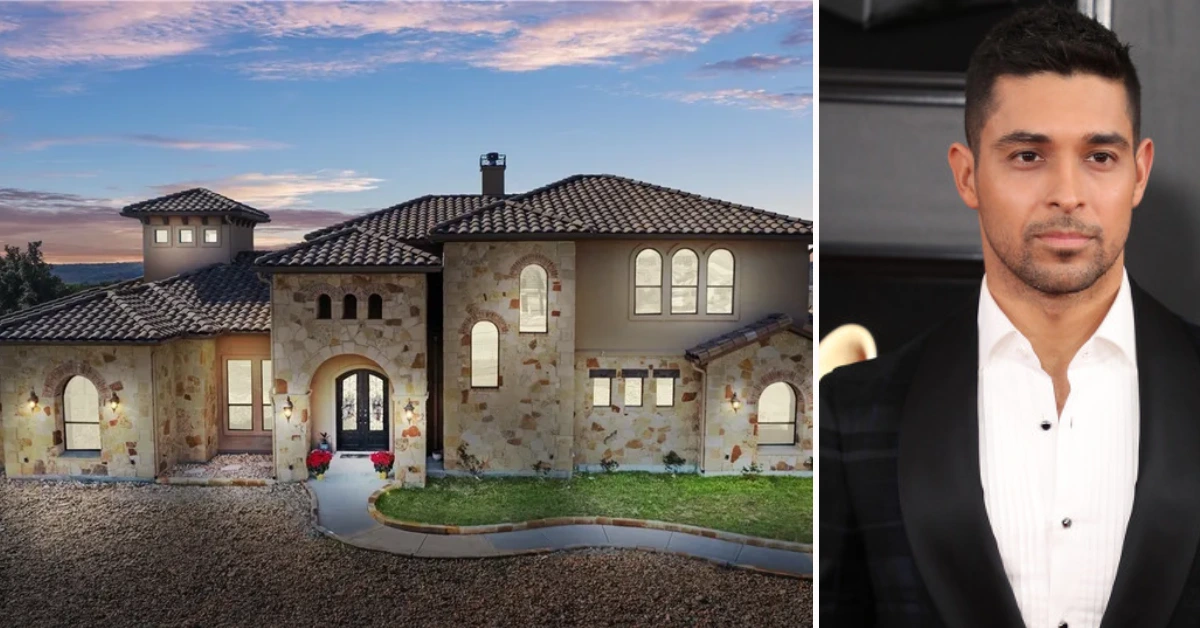
Wilmer Valderrama’s home in Tarzana, California, is more than a celebrity property. It is the physical record of a 20-year renovation, a deliberate design philosophy, and a clear personal vision — one that the actor articulated early on as wanting visitors to feel like “if James Bond and Batman had a baby, and that baby was a house, this is what it would look like.”
What makes the story of this house compelling is not just what it looks like, but why it was built the way it was. Valderrama did not hand the project to a decorator. He drove each creative decision himself, one room at a time, over years, building toward a property he calls his “forever home.”
The Property: Location, Size, and History
The compound sits in Tarzana, a neighborhood in the San Fernando Valley section of Los Angeles, in a gated area of estates surrounded by mature trees. The main house sits on a lot of approximately 3.5 to 4 acres, and the compound includes multiple structures: the primary residence, a guesthouse, a full gym, and a four-car collector-style garage with a rooftop deck.
The house itself carries a significant backstory. Before Valderrama owned it, it was the residence of actor and martial arts champion Chuck Norris. A friend was selling the property and invited Valderrama to tour it. What he found was a six-bedroom, nine-bathroom compound with solid bones — and serious problems. The property was overgrown, the plumbing and wiring were in poor condition, and the interiors were covered in dated carpets and wallpaper. Valderrama saw past all of it and made an offer. He purchased the property in 2005 for approximately $3.525 million.
Then, in 2019, he bought the adjacent property to expand the compound further — giving the growing family even more outdoor space and privacy.
Why He Bought It: The “Forever Home” Mindset
The purchase was not an impulse. By his mid-20s, while still appearing on That ’70s Show, Valderrama had already started thinking long-term. His family had immigrated to the United States from Venezuela, and the weight of that sacrifice shaped how he approached major decisions. He was looking for a home where he could raise children — not a temporary residence between projects.
When he saw the Chuck Norris compound, he understood immediately what it could become. The layout, the land, the trees — the structure gave him what he needed to build on. So he bought it and began, slowly and deliberately, to make it his own.
The Renovation Approach: One Room at a Time
One of the most distinctive things about how this home came together is the pace. Valderrama did not gut the property and rebuild it all at once. Instead, he moved through it room by room, letting each space evolve based on what he was drawn to at the time.
He described this as being “inspired by certain things” he would come across. A piece of furniture would catch his attention; it would spark an idea for the room around it. That idea would spread. The renovation was cumulative rather than planned from a blueprint.
His architect friend April Gray of Lamb & Gray Architects collaborated on key structural and spatial decisions — most notably the kitchen — but the overall creative direction came from Valderrama.
Inside the House: A Room-by-Room Look
The Living Room
The living room was the first major space to be overhauled. Valderrama installed hardwood floors throughout, repainted the walls, and coated the brick fireplace and molding in black — a deliberate choice to add sophistication and create a strong visual backdrop for the art he was beginning to collect.
The room’s most talked-about piece is the Timothy Oulton coffee table, built from a retired Japanese fishing boat propeller. It sits in the center of the space as both furniture and conversation piece. Nearby, an RH Cloud Sofa provides comfortable seating, while a refinished vintage cantina-style bar — left in the home by Chuck Norris, who had it relocated from an old cantina in El Paso, Texas — runs along one wall. Above the bar hang photographs of Lucille Ball and Desi Arnaz, two personal heroes of Valderrama’s.
The room also features photography by Michael Muller and a mural drawing by Mister Cartoon, reflecting Valderrama’s interest in credible, artist-specific work rather than generic interior decoration.
The timber ceiling was retained from the original structure and adds warmth and scale to the space.
The Kitchen
The kitchen is where Valderrama’s personal taste pushed hardest against convention. He was not interested in the white-and-brass aesthetic that dominated celebrity kitchen design around that period. His reasoning was blunt: he did not feel welcome to actually cook in that kind of space.
Working with April Gray, he designed a kitchen that felt functional without sacrificing visual weight. The cabinetry is a chocolate-toned walnut, and every door panel was cut from the same plank — meaning the wood grain runs continuously from top to bottom across the entire row of cabinets. The result is a seamless visual line that removes any sense of visual interruption.
The walls are finished in light blue Roman clay, which sits in deliberate contrast against the dark wood and gray granite surfaces. A skylight was added to bring natural light into what had previously been a dim space, and the windows were replaced with larger, more panoramic glass to pull in both light and views of the surrounding greenery. The flooring is stone-like in texture — chosen for durability over decoration.
The kitchen includes a wine fridge, a hibachi grill, and a dedicated coffee station — all functional priorities that reflect how Valderrama actually uses the space.
The Barbershop
One of the most original rooms in the house started as a memorabilia room. When Valderrama acquired a classic barber chair, the object reshaped the entire space around it. The room became a working barbershop — where his stylist, Christine Nelli, cuts his hair on a weekly basis.
The walls are covered in vintage newspaper pages sourced from a single collector who sold Valderrama approximately 30 years of iconic front pages for $100. The papers were adhered to the walls and then sealed with a durable lacquer finish, a process Valderrama worked out through experimentation with his contractor. The effect is a full room covered in historical headlines — a functional archive built into the walls.
The Skull Collection
Skulls appear throughout the house — on shelves, in the kitchen, across the living spaces — and they are the design element that most clearly reflects Valderrama’s thinking about what a home should communicate.
His explanation is rooted in historical symbolism. In many ancient cultures, skulls were used as protective symbols inside homes, not as symbols of death. Valderrama’s collection includes carved pieces in crystal and stone, as well as original artwork by Ernesto Yerena Montejano in collaboration with Shepard Fairey. The pieces are not decorative filler; each was chosen for its form, material, and what Valderrama calls its “personality and spirit.”
Outdoor Amenities
The compound’s outdoor spaces are built around the same logic as the interior: serious investment in quality, oriented toward real use.
The centerpiece is the resort-style pool, which features a beach-entry design, a waterfall grotto, and a water slide. Adjacent to the pool is a hot tub and spa area. A full gym sits in a separate structure on the property, equipped with a dedicated outdoor basketball court. The guesthouse provides accommodations for visitors without requiring access to the main house.
The four-car collector’s garage comes with a rooftop deck and BBQ area — designed for outdoor entertaining at height, with views across the property.
Mature trees surround the entire compound, providing both privacy and the sense of being removed from the city despite being minutes from central Los Angeles.
The Property as a Family Home
Valderrama has spoken clearly about his long-term vision for the property. From the time he purchased it, the goal was to raise children there. That goal has now materialized.
He and his fiancée Amanda Pacheco — who got engaged on New Year’s Day 2020 — have made the compound their primary family residence. Their daughter Nakano Oceana was born in 2021, and as of early 2025, the couple announced they are expecting a second child.
The home’s six bedrooms, multiple structures, and expanded grounds — including the adjacent property purchased in 2019 — position the compound well for a growing family. Valderrama has described the design as oriented toward both adult living and a space where children can grow up with room to move.
Key Facts at a Glance
- Location: Tarzana, California (San Fernando Valley, Los Angeles)
- Previous owner: Chuck Norris
- Purchase year: 2005
- Purchase price: Approximately $3.525 million
- Bedrooms: 6
- Bathrooms: 9
- Lot size: Approximately 3.5–4 acres (expanded in 2019 with adjacent purchase)
- Structures: Main house, guesthouse, gym, 4-car garage with rooftop deck
- Architect: April Gray, Lamb & Gray Architects
- Notable items: Timothy Oulton boat propeller coffee table, Chuck Norris-era cantina bar, in-home barbershop, skull collection by multiple artists
- Vehicles: 1967 Ford Mustang
What Sets This Home Apart
Most celebrity homes are curated by design firms to project a general version of luxury. Valderrama’s compound moves in a different direction. Every room contains objects with a traceable story — the coffee table from a decommissioned vessel, the bar relocated from a Texas cantina, newspaper headlines lacquered to a wall, skulls connected to specific artists and historical traditions.
The renovation took years precisely because Valderrama refused to rush it. He allowed rooms to develop around the objects and ideas that found their way to him, rather than imposing a uniform aesthetic from the start. The result is a home that reads as genuinely personal rather than professionally assembled.
For a property that started as an overgrown, plumbing-impaired compound in an unlikely corner of the San Fernando Valley, what Valderrama built here is a clear expression of intent — both about who he is and the life he planned to build inside it.