
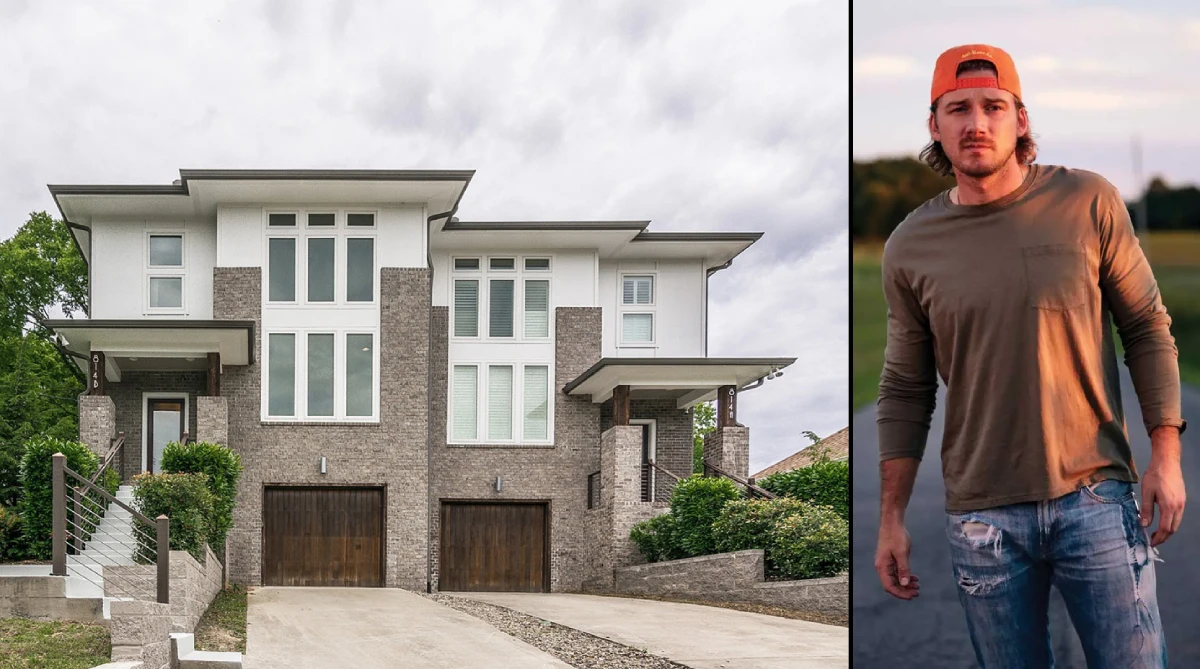
Morgan Wallen has quietly built one of the most talked-about real estate portfolios in country music — not by chasing flashy celebrity addresses, but by doubling down on the Tennessee privacy his career has demanded. His latest move, a sprawling estate that fans and social media creators have dubbed the ‘God’s Country’ mansion—a nickname that aligns with Wallen’s 2019 hit song and rural branding, though Wallen himself hasn’t publicly used the term for the property.
This article covers every known detail about Wallen’s new home, how it fits into his broader property history, and what his real estate choices actually reveal about the man behind the music.
From Nashville Townhouse to a Private Mansion
Wallen’s residential journey mirrors his career arc almost exactly — each property reflecting a new chapter defined by success, controversy, or the desire to disappear from public scrutiny.
In April 2020, he closed on a 2,759-square-foot Prairie-style home in Nashville’s Melrose neighborhood for $700,000. The property was part of a two-unit attached structure, each side with its own entrance and garage. Inside, the home featured four bedrooms, three bathrooms, a living room with a tiled fireplace, built-in shelves, and a kitchen with a long island and French door access to a fenced backyard. A rooftop deck offered downtown Nashville views. An upper-floor primary suite with a tiled chaise lounge built into the glass-walled shower and a built-in wine bar made it a genuinely polished space for a rising country star.
He sold the property in July 2021 for $835,000 — a clean exit following the now-documented incident in which a neighbor’s camera captured him using a racial slur in the driveway. That moment accelerated a personal pivot Wallen had apparently already been planning: trading visibility for acreage.
What We Know About the “God’s Country” New House
Reports and social media tours describe Morgan Wallen’s current primary residence as an ~$8 million estate outside Nashville, though the exact price and layout have not been officially confirmed by Wallen or public records. Reports from 2025 characterize it as a significant upgrade in both scale and security — a private compound that reflects the kind of infrastructure a chart-dominating, arena-filling act genuinely needs rather than simply wants.
The property is associated with extensive modern living spaces and a level of seclusion that his previous urban home could never provide. High-end security systems and expansive grounds are noted features, though Wallen has kept the specific layout and design details tightly guarded — consistent with how he has managed every aspect of his private life since 2021.
The “God’s Country” label, whether informal or deliberately cultivated, aligns naturally with the rural identity Wallen has built into his public image. He has spoken openly about needing to stay grounded in his Southern roots to keep his songwriting authentic: “I’m not gonna know what to sing about if I get too far removed,” he told People in 2021. A property of this scope — isolated, land-heavy, and functionally self-contained — is the physical extension of that philosophy.
The 1,700-Acre Tennessee Farm
Before the “God’s Country” mansion entered the conversation, Wallen made a land acquisition that arguably reshaped his entire relationship to privacy and space.
In 2023, he purchased approximately 1,700 acres of rural Tennessee land alongside his friend and booking agent, Austin Neal. The purchase was confirmed in a December 2023 Billboard cover story and represented a major strategic shift — not a home in the traditional sense, but a working outdoor property suited to hunting and fishing. Wallen had mentioned his intentions as far back as 2021: “I’d like to have some trails and also some fields, and hunt a little bit, maybe a pond to fish on.”
The land sits outside Nashville but remains within a practical drive of the city — a configuration that allows Wallen to maintain access to Music City while living at a remove from it. Wallen’s 1,700-acre Tennessee farm purchase was confirmed in a December 2023 Billboard cover story. Whether the rumored $8 million residence sits on this land or represents a separate property remains unconfirmed. The two acquisitions reflect the same strategy: prioritizing privacy, land, and distance from urban scrutiny.
What makes this property significant from a real estate standpoint is the intent behind it. Wallen isn’t buying acreage for investment or resale. He’s buying solitude. “I play my shows, I hang out with my son, and I hide pretty much. And I’m OK with that. I’m happy as hell with that,” he told Billboard.
The Barndominium: A Third Property in the Portfolio
While some fan forums and real estate blogs mention a possible barndominium-style property in Wallen’s portfolio, no verified public records, interviews, or credible media outlets have confirmed this specific holding. This property type — a barn-style structure converted or built as a full residential dwelling — fits naturally with the rural aesthetic Wallen gravitates toward both personally and professionally.
Few details about this specific property have been made public. It may function as a secondary residence, a recording space, or simply a holding on the broader land he acquired. What it confirms, however, is that Wallen’s approach to property is deliberate and layered — not a single marquee address, but a network of spaces built around different needs.
Why Wallen Keeps Moving Further from the City
The pattern across every residential decision Wallen has made is consistent: each move increases distance from public access, decreases media exposure, and expands the amount of raw land surrounding him.
His Melrose townhouse, while private in the way any gated Nashville property is, was fundamentally urban. It had a driveway visible from the street, neighbors within earshot, and proximity to a city that recognized his face. After the 2021 incident, that proximity proved costly — not just reputationally, but personally.
His subsequent choices stripped those vulnerabilities away entirely. Twelve hundred square feet becomes 2,759 square feet, which becomes 1,700 acres. A shared driveway becomes a compound with security infrastructure. There’s a logic here that has nothing to do with celebrity excess and everything to do with a man who has told interviewers he can no longer go to a grocery store without arrangement, who enters doctors’ offices through back doors, and who has found that the size of his fame and the size of his preferred life are in direct conflict.
The $8 million estate is where that conflict gets managed, at least for now.
The Downtown Bar: The One Public-Facing Real Estate Exception
Wallen’s only deliberate step toward public life, real estate-wise, was the opening of Morgan Wallen’s This Bar & Tennessee Kitchen in downtown Nashville in June 2024. The six-story venue, developed in partnership with TC Restaurant Group, includes three live music stages, six bars, a rooftop deck, and a menu that features recipes from Wallen’s mother.
It’s worth noting precisely because it runs counter to every other property decision he has made. While his homes have gotten bigger, more remote, and less accessible, this bar was designed to invite thousands of strangers in. The name comes from a track on his 2021 album Dangerous, and the concept — according to the bar’s own materials — is meant to be an authentic extension of his music and Tennessee identity.
That duality defines Wallen’s relationship with space: ruthlessly private in where he lives, deliberately public in how he earns.
What’s Next for Morgan Wallen’s Real Estate?
With the I’m The Problem Tour extending into 2026 and his Nashville bar now operational, industry watchers speculate Wallen may expand his commercial holdings. But for his private life? Expect more land, more gates, and more Tennessee sky.
What Morgan Wallen’s Real Estate Choices Actually Reveal
The through-line across Wallen’s property history is not wealth accumulation — it’s boundary-setting. Each major purchase has been a structural response to a personal or professional turning point. The Melrose townhouse was bought by a rising artist. It was sold by a man who needed to start over. The farm was bought by someone who had learned, at high cost, what unsupervised proximity to the public can do to a career and a life.
The new $8 million estate represents the logical endpoint of that trajectory: a home scaled to the level of his success, secured to the level of his notoriety, and located in the Tennessee landscape that continues to be both his subject matter and his sanctuary.
For a songwriter who insists his authenticity depends on staying connected to where he came from, building an $8 million compound in rural Tennessee isn’t a departure from his roots — it’s the most expensive way to protect them.