
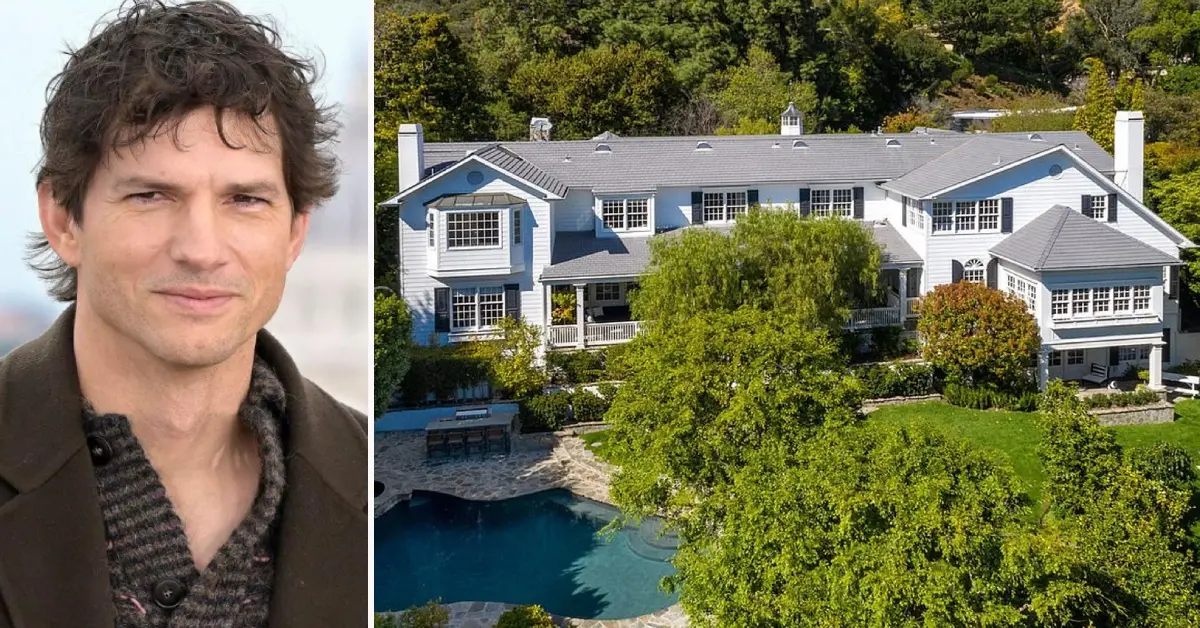
When most people picture a celebrity home in Beverly Hills, they imagine something flashy — columns, fountains, gold fixtures. Ashton Kutcher and Mila Kunis built the opposite. Their primary home is a working farmhouse powered entirely by solar energy, where they planted corn during the pandemic and named the property after themselves. It is one of the more unusual real estate stories in Hollywood, and one of the more thoughtfully designed homes in Los Angeles.
This article covers every significant property in Ashton Kutcher’s real estate history — the farmhouse that made architecture headlines, the Beverly Hills mansion they eventually sold, the Santa Barbara beach house, and the earlier homes he owned before his marriage to Mila Kunis.
KuKu Farms: The Beverly Hills Farmhouse That Surprised Everyone
What the Property Actually Is
Sitting on six acres perched high above Beverly Hills, the main residence consists of a main house, a guesthouse and entertainment barn, manicured gardens, and a barbecue pavilion. The couple nicknamed it KuKu Farms — a blend of Kutcher and Kunis — and the name fits. They dug a well on the property to irrigate the land and planted and harvested a field of corn during the COVID lockdown.
What makes the property architecturally notable is the deliberate rejection of typical Beverly Hills excess. As Mila Kunis put it directly: “We wanted a home, not an estate.”
How It Got Designed
The couple launched their five-year project by assembling independent Pinterest boards to flesh out their individual visions. When they compared notes, 90 percent of the images they had each chosen were the same, and most of the houses they had pinned were designed by the same architect.
That architect was Howard Backen of Backen & Gillam Architects, an AD100 firm known for modern farmhouse design. Backen is a master of distilling vernacular forms and rustic materials into something bright and contemporary.
Kutcher and Kunis played a significant role in the process, getting into details like beam sizes and cross bracing — not the kind of conversations Backen typically has with clients.
For the interiors, they brought in Vicky Charles of Charles & Co. Charles incorporated iconic pieces from their previous homes, including a set of custom silver throne chairs Kutcher had commissioned on a trip to India, and a dramatic 10-foot crystal chandelier that she placed in the entertainment barn — a deliberately theatrical contrast to the barn’s humble structure. Future Home Theater
Architecture and Materials
Reclaimed oak wood floors, board-form concrete walls, 19-foot sliding glass windows, and exposed wood beam ceilings define the material palette throughout the property. The structure is arranged along a central axis so that the views of the valley below are visible from nearly every interior space. Californiaenergydesigns
Inside and outside flow into each other throughout the property. One of the couple’s primary goals was creating a home that felt connected to the land rather than separate from it. Hommes Studio
Kutcher described the design philosophy this way: “To feel tranquility in a space, everything needs to be in order. If the world around you isn’t in order, it’s hard to get your brain in order. When we’re in our home, the world just makes sense.”
Sustainability at the Core
This is not a celebrity home with a few token green touches. The property is powered entirely by photovoltaics, concealed from view above the main porch. The solar array produces more energy than the property actually uses. Californiaenergydesigns
The engineering challenges were significant. The tall exposed wood ceilings and full-length glass windows required creative solutions for airflow and ductwork. The entertainment barn, with floor-to-ceiling glass on two sides, required its own ventilation and temperature management approach. The barbecue pavilion and pool area needed compact, open-air climate control for hot Los Angeles summers. Californiaenergydesigns
One of the couple’s stated goals is to eventually exceed current legislation and distribute their own locally generated energy back into the grid. Hommes Studio
The farmhouse was featured on the cover of Architectural Digest’s June 2021 issue — a recognition that the design accomplished something genuinely unusual for its location and budget tier.
The Beverly Hills Mansion They Sold
Before KuKu Farms was finished, Kutcher and Kunis lived in a more conventional Beverly Hills property in the Hidden Valley neighborhood.
The 7,400-square-foot “East Coast Traditional” was built in 1999 and located at 9588 Lime Orchard Road. The five-bedroom house featured a cook’s kitchen, wine room, sauna, mahogany-paneled office, and a small shaded pool on its half-acre grounds.
Kutcher and Kunis bought the home in 2014 for nearly $10.2 million. They listed it in 2020, relisted in September of that year for $12.3 million, then dropped the price to $11.3 million before it eventually sold in early 2022 for $10.4 million. The buyer’s identity was not disclosed.
The house sat in a neighborhood with notable neighbors — Adele, Katy Perry, and Jennifer Lawrence have all owned nearby properties. The sale closed shortly after their Architectural Digest farmhouse feature came out, marking a clean transition from one chapter to the next.
The Santa Barbara Beach House in Carpinteria
Kutcher and Kunis purchased a six-bedroom, six-bathroom oceanfront beach house in Carpinteria — a beach town just south of Santa Barbara — for $10 million. The purchase happened in 2017, making it a vacation home they have held for several years alongside their Beverly Hills main residence. Trulia
The 3,100-square-foot home has an open floor plan with ocean views from inside the house. The interior follows California coastal design — bright white walls, hardwood floors, and beach-influenced decor. TODAY.com
The property has ocean views on one side and the Santa Ynez Mountains on the other, with both a ground-level porch and a second-floor balcony. The eat-in kitchen has a large peninsula suited to casual family use. Fox News
The Carpinteria house functions as a private escape from their Beverly Hills base. The area has become increasingly popular with the celebrity set — Natalie Portman also bought a property nearby in Montecito around the same period.
Ashton Kutcher’s Earlier Properties
Before his marriage to Mila Kunis, Kutcher’s real estate history looked quite different.
During his marriage to actress Demi Moore, the couple owned a substantial Beverly Hills residence together. After their separation, Kutcher moved into a Hollywood Hills bachelor pad — a more compact, private retreat suited to that period of his life.
Neither of those properties came close to the architectural ambition of what he and Kunis eventually built together at KuKu Farms. The farmhouse project represented a significant shift in how Kutcher approached home ownership — from buying existing properties to building something from scratch over five years with a clear point of view.
What Sets the Kutcher-Kunis Properties Apart
Most celebrity real estate coverage focuses on price tags and square footage. The more interesting story with Ashton Kutcher’s homes — particularly KuKu Farms — is the thinking behind them.
A few things stand out:
-
- They built slowly and deliberately. Five years is a long time to commit to a single project before moving in. Most high-net-worth buyers buy finished homes. Kutcher and Kunis designed theirs from scratch and stayed involved at the technical level throughout.
- The sustainability is structural, not cosmetic. The solar system was engineered into the building from the start, not added later. The goal of producing surplus energy and eventually distributing it locally reflects a longer-term position than what most celebrity homes represent.
- The interiors mix high and humble. A 10-foot crystal chandelier hanging in a working barn, silver throne chairs in the bathroom — these choices show a willingness to have fun with the tension between raw materials and unexpected luxury, rather than defaulting to uniform opulence.
- They sold down rather than up. Moving from a 7,400-square-foot East Coast Traditional mansion to a farmhouse on six acres is not a conventional upgrade. The square footage is less important to them than the quality of the land and the coherence of the design.
Conclusion
Ashton Kutcher’s real estate portfolio tells a consistent story: early in his career, conventional celebrity choices; post-marriage, something more considered. KuKu Farms is the clearest expression of what he and Mila Kunis actually value in a home — land, sustainability, function, and the absence of ostentation. The Beverly Hills mansion is sold. The Santa Barbara beach house remains a coastal retreat. And the farmhouse, designed over five years with Howard Backen and Vicky Charles, stands as the property most likely to be remembered long after the celebrity headlines fade.