
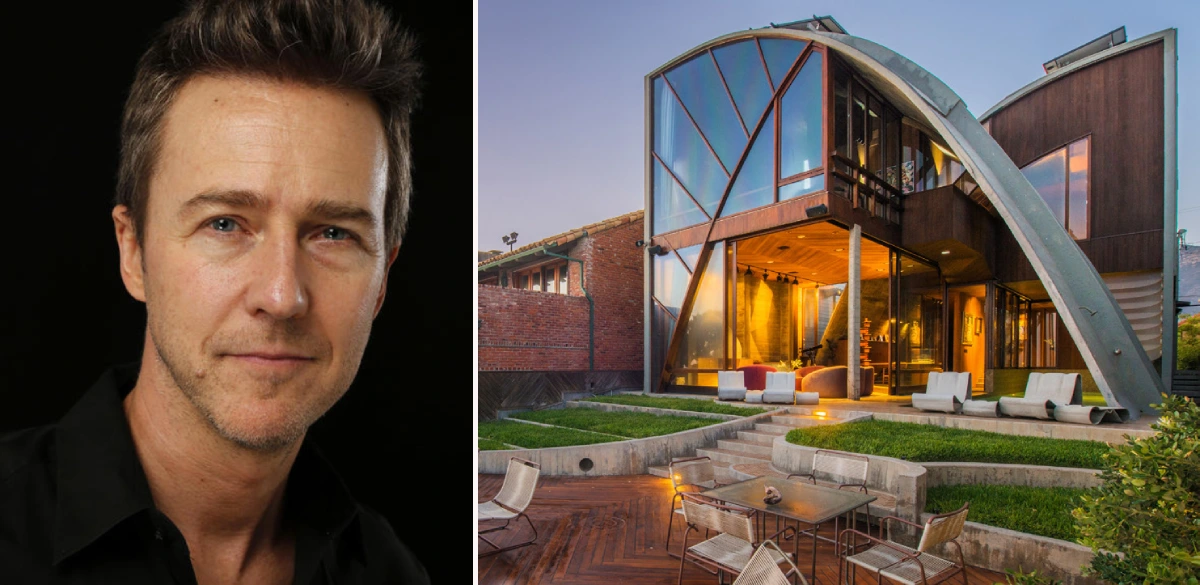
Edward Norton is one of the most respected actors of his generation — a Yale-educated performer with a reputation for choosing roles that challenge, not just entertain. His real estate choices reflect the same instinct. In 2017, Norton purchased one of the most architecturally significant homes in Malibu: the John Lautner-designed Stevens House, a California State Cultural Landmark sitting directly on the beach at 78 Malibu Colony Road.
This is not a typical celebrity home purchase. It is a building with a documented history, a precise engineering story, and a place in the formal record of American architecture. This article covers everything that matters about the property — where it is, what makes it architecturally significant, how it was built, what it looks like inside, who owned it before, and what it says about Norton’s wider approach to real estate.
Where Edward Norton Lives: Malibu Colony
The Stevens House sits inside the Malibu Colony, a gated beachfront community on the Pacific Coast Highway that has served as a private retreat for Hollywood figures since the early days of the film industry. Residents and former residents have included Leonardo DiCaprio, Tom Hanks, and Jackie Collins, among others. Privacy is the defining feature of the Colony — guarded gates, direct beach access, and a strict sense of separation from the broader Malibu coastline.
The specific address, 78 Malibu Colony Road, places Norton’s home directly on 37 feet of sandy beachfront. The lot itself measures 90 feet deep by 37 feet wide — a tight, almost narrow parcel that would have made most architects say the brief was impossible. John Lautner did not say that.
- Address: 78 Malibu Colony Road, Malibu, California
- Architect: John Lautner
- Year Built: 1968
- Size: 3,366 square feet, split-level
- Bedrooms/Bathrooms: 5 beds / 5 baths
- Lot: 90 ft deep × 37 ft of beachfront
- Purchase Price: $11.8 million (July 2017)
- Historic Status: California State Cultural Landmark; National Register of Historic Places (2010)
- Previous Owner: Michael LaFetra (purchased 2007 for $13.8 million, restored 2009–2010)
- Key Features: Two half-catenary concrete curves, 14 I-steel beams, cedar interior planking, custom Douglas fir sliding doors, horseshoe staircase, basement screening room/sauna/gym, covered pool, solar energy, cork flooring
Who Built It and Why It Matters
John Lautner is one of the defining figures of 20th-century American residential architecture. A student of Frank Lloyd Wright — with whom he trained starting in the late 1930s — Lautner eventually broke out on his own and spent the following decades producing California homes that defied conventional building logic.
His portfolio includes the Chemosphere House in Los Angeles (1960), described by Encyclopædia Britannica at the time of construction as the most modern home built in the world. He also designed the Bob and Dolores Hope Palm Springs residence, and several of his buildings have been used as film sets — most famously in Diamonds Are Forever and Body Double.
The Stevens House, completed in 1968, was Lautner’s first commission in Malibu. It was also the project that set the tone for the type of coastal homes that followed in the area.
The original client, Dan Stevens, approached multiple well-known architects with a single brief: design a five-bedroom, five-bathroom home with a pool on a 90-by-37-foot oceanfront lot. Every architect he consulted told him it could not be done. Stevens then called Lautner.
The Engineering Behind the Design
Lautner solved the problem with a structural system that is as much sculpture as it is construction. He used 14 I-steel beams running through the house to support two half-catenary curves positioned in opposite directions. The result, in concrete, becomes simultaneously the exterior walls, the roof, and the ceiling — all in one continuous form.
From the outside, the structure unmistakably resembles two crashing waves. This was intentional. Lautner’s stated concept for the house was a design that “goes with waves,” directly reflecting the Pacific that the home faces. Inside, the same curved geometry gives every room a nautical, boat-like feel, as though you are living inside the hull of a large vessel.
The home is built from a combination of concrete and wood. The concrete handles the structural curves, while cedar planking covers the interior surfaces — walls, ceiling, and built-in cabinetry throughout. Lautner specified massive custom glass and Douglas fir sliding doors that retract completely, opening the interior to the ocean air and erasing the boundary between inside and outside.
The total living space is 3,366 square feet spread across a split-level layout with five bedrooms and five bathrooms. A horseshoe-shaped staircase connects the levels internally. The basement holds a screening room, sauna, and exercise room.
The Interior: What the House Actually Looks Like
The interior language is consistent throughout — warm, wood-heavy, and shaped by the curved geometry of the shell around it.
The kitchen follows the same material palette as the rest of the house: hardwood floors, wood-paneled walls, wood ceiling, and wood cabinetry, all in complementary tones with varying inlay details. One notable feature is a built-in retro diner-style booth where a conventional kitchen table would normally sit.
The living room steps down from the main floor level and opens directly toward the ocean through retractable glass walls. A modern fireplace set against a concrete wall anchors the space on one end. The cedar herringbone ceiling features recessed lighting, ensuring the room works at night without losing the warmth of the wood overhead.
The primary bedroom faces the ocean directly, with glass walls replacing solid exterior surfaces on the ocean-facing side. The covered swimming pool sits along the side of the house and leads out to a large beach deck at the front.
When the restoration was completed before Norton’s purchase, sustainable cork flooring was installed throughout, and the home was converted to solar energy — both additions that aligned with the next owner’s environmental commitments.
The Property’s History Before Norton
The Stevens House did not arrive at Norton’s hands in mint condition. It went through periods of neglect and modification before a significant restoration brought it back to something close to Lautner’s original vision.
Michael LaFetra, an actor and producer, purchased the home in 2007 for $13.8 million. LaFetra undertook a comprehensive restoration that involved replacing all cedar planking, restoring concrete surfaces that had been painted over during earlier renovations, and reinstating lofts in the children’s bedrooms that Lautner had originally designed but that were never fully built. LaFetra also had the original tile recreated and brought the sustainability features up to date.
As a direct result of this restoration effort, the Stevens House was added to the National Register of Historic Places in 2010 and registered as a California Historic Cultural Landmark (Historic Cultural Monument No. 09000802). The restoration ran from April 2009 to March 2010.
The house went on and off the market in the years following. When Norton purchased it in July 2017, he paid $11.8 million — less than what LaFetra had paid a decade earlier, though the property had significantly appreciated in cultural and architectural status by that point.
Why Edward Norton Bought This House Specifically
To understand why Norton chose this property, it helps to know something about his background and what he has consistently said matters to him.
Norton grew up in Columbia, Maryland — a planned city developed in part by his maternal grandfather, James Rouse, a prominent real estate developer and urban planner credited with transforming how Americans think about suburban community design. Norton is, in a direct lineage sense, the grandson of someone who shaped built environments at scale.
His own real estate choices reflect an ongoing interest in architecturally significant and historically registered properties rather than new construction. The Stevens House — a nationally registered landmark designed by one of California’s most important residential architects — fits that pattern precisely.
Norton is also a visible environmental advocate. He serves as a United Nations Goodwill Ambassador for Biodiversity, co-founded the fundraising platform CrowdRise (later acquired by GoFundMe), and has invested in solar energy initiatives. The Stevens House, running on solar power with sustainable cork flooring, was not in conflict with those commitments. It aligned with them.
Norton’s wife, Canadian film producer Shauna Robertson, who he married in 2012, co-owns the property. The couple has a son, Atlas, born in 2013.
Edward Norton’s Broader Real Estate Portfolio
The Malibu property is Norton’s most architecturally significant holding, but it is not his only real estate asset. He maintains a presence in New York City as well, where he owns property in Greenwich Village — a neighborhood he has been associated with for years.
His real estate approach mirrors his career decisions: deliberate, historically grounded, and resistant to the obvious choice. He has not chased new construction or trophy properties in the conventional sense. The Stevens House is, among other things, a building that required an enormous amount of institutional knowledge to appreciate fully — which makes it a fitting choice for someone who graduated from Yale with a history degree and has spent decades as one of Hollywood’s most analytically minded performers.
John Lautner’s Legacy and the Stevens House in Context
The Stevens House holds a specific place within Lautner’s body of work. Unlike his more overtly futuristic Googie-influenced designs — the flying saucer geometry of the Chemosphere, the volcanic drama of the Hope residence — the Stevens House represents Lautner working in a more directly naturalistic mode. The form is derived from the ocean itself, not from aerospace or atomic-age imagery.
That distinction matters. It shows the range of Lautner’s thinking. He was not locked into a single formal language. He designed in response to site, client, and context. At Malibu Colony, on a narrow beachfront lot where the Pacific is always present, he let the ocean dictate the form.
The house was documented in Architectural Record Houses of 1971, photographed by Julius Shulman — the definitive photographer of California modernism — and included in scholarly discussions of Lautner’s work, including the 2008 exhibition Between Earth and Heaven: The Architecture of John Lautner at the Hammer Museum in Los Angeles.
It was Lautner’s first Malibu commission and, by most accounts, the project that defined what architectural ambition on that coastline could look like.
Conclusion
Edward Norton’s Malibu house is not famous because a celebrity owns it. It was famous before Norton arrived and will remain significant long after any ownership change. The Stevens House is one of the clearest examples of John Lautner’s ability to solve an engineering problem through pure architectural thinking — a building shaped by its site, structured from the inside out, and designed to age well precisely because its logic is so clearly stated.
Norton’s decision to buy it reflects the same instinct that has driven his career: choose substance over surface, and invest in things that hold their value because they were built right in the first place.