
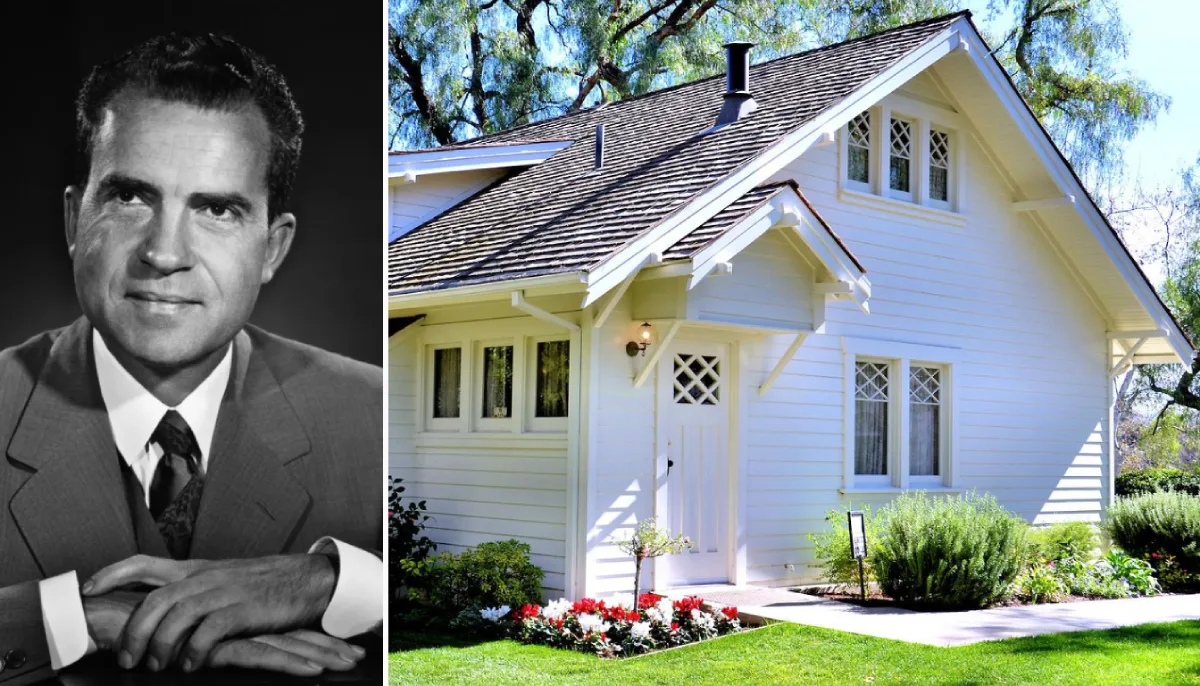
Richard Nixon is one of the most studied — and debated — figures in American presidential history. He rose from a modest farmhouse in rural California to occupy the most powerful office in the world, only to resign in disgrace. The places he called home tell that story as clearly as any biography. Three properties sit at the center of his life: the small Yorba Linda farmhouse where he was born, the oceanfront estate in San Clemente that served as his presidential retreat, and the Florida compound where he first learned of the Watergate break-in. Each one holds a distinct piece of the Nixon story.
This article covers all three — with the deepest focus on La Casa Pacifica, the “Western White House” in San Clemente — along with what you can actually visit today and what these properties reveal about Nixon the man.
The Yorba Linda Birthplace: Where It All Started
Richard Milhous Nixon was born on January 9, 1913, in a small, 1.5-story farmhouse in Yorba Linda, California, a rural stretch of Orange County that bore little resemblance to the prosperous suburb it eventually became.
The house was built in 1912 from a mail-order construction kit by Richard’s father, Francis A. Nixon, on ranchland the family owned. The phrase “mail-order kit” is worth sitting with — it wasn’t a custom-built home. It was a prefabricated structure assembled by a father who worked hard with his hands and very little money. The family grew lemon trees on the surrounding land and lived in that house until 1922, when they relocated to Whittier, California.
That home’s later history reflects just how ordinary its origins were. The 1.5-story house passed through various owners and was even used as an elementary school until Yorba Linda designated it a historic site in 1959. It took Nixon’s own political success — and the establishment of a nonprofit library organization after his 1968 election — to bring the property into formal preservation.
What the Birthplace Reveals
The contrast between this farmhouse and La Casa Pacifica, which Nixon would buy for $1.4 million just months after taking office, is jarring. That contrast is part of what makes the birthplace worth understanding, not just visiting. Nixon spent his entire career presenting himself as a self-made man, a product of working-class California who had earned his position through grit. The Yorba Linda house is the physical evidence for that argument.
Nixon’s father Frank built the house in 1912, and Frank and his wife Hannah ran a citrus ranch on the surrounding land — land that now forms the site of the Nixon Presidential Library and Museum.
The Nixon Presidential Library and Museum: Visiting Both Houses
Located in Yorba Linda, California, on land that Nixon’s family once owned, the library is one of 13 administered by the National Archives and Records Administration. The 9-acre campus incorporates the Richard Nixon Birthplace, a National Historic Landmark where Nixon was born in 1913 and spent his childhood.
The library was dedicated on July 19, 1990, with Nixon himself present, along with former presidents George H.W. Bush, Gerald Ford, and Ronald Reagan. Nixon reportedly said at the ceremony, “Nothing we have ever seen matches this moment — to be welcomed home again.” The library underwent an extensive renovation in 2016 and now features updated multimedia exhibits.
What You Can See Inside
The museum doesn’t gloss over the difficult parts of Nixon’s record. Exhibits address Vietnam, Watergate, and Nixon’s resignation directly. Highlights include:
- A replica of President Nixon’s Oval Office with the original 1969 California blue and gold decor hand-selected by First Lady Pat Nixon, where visitors can sit behind the president’s desk for a photo.
- The presidential helicopter, Army One — a six-ton Sikorsky VH-3A “Sea King” model used by Presidents Kennedy, Johnson, Nixon, and Ford.
- The actual birthplace farmhouse, open for guided tours throughout the day, furnished with approximately 80% of the original items. Nixon’s brother kept many of these objects, anticipating they might one day be historically significant.
- An exact replica of the White House East Room, which is also leased out as an event space.
- Exhibits on Nixon’s opening of relations with China in 1972, his domestic policy achievements including the creation of the Environmental Protection Agency, and the full arc of the Watergate scandal.
Address: Richard Nixon Presidential Library and Museum, 18001 Yorba Linda Boulevard, Yorba Linda, California 92886. Open seven days a week.
Nixon and Pat Nixon are both buried on the library grounds, just a few feet from the birthplace house.
La Casa Pacifica: The Western White House in San Clemente
Of all the properties associated with Nixon, none carries more historical weight than La Casa Pacifica. It was his favorite place, his operational base outside Washington, and — after his resignation — his place of exile. Understanding it means understanding a presidency.
The Estate Before Nixon
La Casa Pacifica is a classic California beachfront mansion located in the gated community of Cottons Point Estates/Cypress Shores in the South Orange County beach town of San Clemente, overlooking the Pacific Ocean from its blufftop position.
Built in 1926 for Hamilton H. Cotton, one of San Clemente’s founding financiers, the estate is a striking example of Spanish Colonial Revival architecture. Designed by architect Carl Lindbom, it features white stucco walls, red tile roofs, arched colonnades, and wrought-iron balconies. The home was modeled after a country estate in San Sebastián, Spain. Even before Nixon arrived, it had already hosted President Franklin D. Roosevelt, who was acquainted with Cotton and admired the property.
The estate wasn’t just a house — it was built to impress. And it did, long before a president ever claimed it.
How Nixon Found It and What He Paid
In April 1969, just months after his inauguration, Nixon sold his Fifth Avenue apartment in New York City and purchased a 10-room mansion on a bluff overlooking the Pacific Ocean in the quiet town of San Clemente. Nixon had personal ties to this stretch of coastline — in March 1940, he had proposed to Pat Ryan in a black Oldsmobile parked at Dana Point, watching the sun set over the San Clemente coast.
A young campaign aide named Fred Divel was asked to search the coast of Southern California for a presidential hideaway. Divel found the Cotton estate at the southernmost end of the then-sleepy San Clemente, immediately adjacent to the northern border of Camp Pendleton Marine Base. The location was ideal: secluded, beautiful, and defensible.
The purchase price became controversial. The White House initially reported the purchase price as $340,000 with Nixon putting $100,000 down. But investigators revealed in 1973 that Nixon had paid at least $1.4 million for the property and received a $450,000 loan from close friend and industrialist Robert Abplanalp. The discrepancy fed into the broader narrative of deception surrounding his presidency.
Modifications Made for the Presidency
Nixon didn’t just move in — he transformed the estate to meet both personal preferences and the serious operational demands of a sitting president.
After purchasing the estate, Nixon replaced the tennis court with a swimming pool and wrapped much of the estate in a 1,500-foot C-shaped wall. A private group constructed a seven-hole golf course on the property. Helicopter pads were built on a nearby parcel. Temporary office buildings went up on an adjacent former Navy radar facility, creating the full infrastructure of a working White House — conference rooms, briefing rooms, secure communications lines, and all the equipment needed to run a government from 3,000 miles away from Washington.
The swimming pool was surrounded by a bulletproof windscreen. The Secret Service built a long perimeter wall and stationed agents in staff buildings across the grounds.
A 1974 House committee found that the federal government had spent $1.7 million on La Casa Pacifica and a second Nixon property in Key Biscayne, Florida. Critics targeted individual line items — including $2,000 for a flagpole and $100,000 for shrubbery — though much of the spending had gone toward legitimate security and communications infrastructure.
Today, the estate covers approximately six acres with about 9,000 square feet of living space, tile and hardwood flooring, arched doorways and detailed groin-vaulted ceilings. Key features include the ocean-view office used by Nixon, an entertainer’s pavilion, and a master suite with an expanded bathroom. Formal living spaces open to a classic hacienda-style patio courtyard with a hand-painted tile fountain at its center. The rose garden contains a magnolia that Pat Nixon brought as a seedling taken from the magnolia tree Andrew Jackson planted at the White House.
Why Nixon Named It La Casa Pacifica
Nixon renamed the estate “La Casa Pacifica” — Spanish for “The House of Peace.” The name wasn’t accidental. He took office during the Vietnam War, and the phrase “peace with honor” was central to how he wanted his presidency defined. Naming his personal retreat after peace was a deliberate statement of intent.
Nixon’s La Casa Pacifica was the first presidential home to be dubbed “The Western White House.” This term has since been used to describe other presidents’ secondary homes, including George W. Bush’s ranch in Crawford, Texas, and Ronald Reagan’s Rancho del Cielo in Santa Barbara County. Nixon didn’t just name his own retreat — he created a category.
A Fully Functioning Presidential Headquarters
This is the point most summaries miss: La Casa Pacifica was not a vacation home in any conventional sense. It was a parallel government.
During the time Nixon spent in San Clemente, the government was run from the Western White House. Formal entertaining took place within the 14 rooms of La Casa Pacifica or around the swimming pool. Cabinet and National Security meetings took place in the temporary office buildings that transformed the adjacent Coast Guard station into a working White House.
Several times a year, Nixon stayed for periods of a week to a month. He traveled to La Casa Pacifica by helicopter after landing at Camp Pendleton on a presidential plane. Special orders were given to local police to retrieve a black briefcase first in any helicopter crash — a briefcase containing nuclear launch codes.
World Leaders at La Casa Pacifica
According to the Orange County Register, 17 heads of state visited Nixon at La Casa Pacifica, including South Vietnamese President Nguyen Van Thieu and Soviet Premier Leonid Brezhnev. Nixon also hosted celebrities including Frank Sinatra and John Wayne.
The most historically significant of these visits was the 1973 Brezhnev summit. At the Second Soviet Summit in June 1973, Nixon and Brezhnev signed the Joint U.S.-U.S.S.R. Communiqué outside La Casa Pacifica. These were not ceremonial visits — they were working diplomatic sessions, advancing arms control negotiations at a critical point in the Cold War.
At one point during that summit, Brezhnev reportedly told Nixon: “I would very much like that the name of this house, La Casa Pacifica, would be symbolic. I would very much like that our relations go down in history as relations of peace, of friendship, of mutual respect.” The informal setting of the California coast played a real role in how those conversations unfolded — the relaxed atmosphere was a deliberate element of Nixon’s diplomatic approach.
Watergate and the Shadow Over San Clemente
As the Watergate scandal escalated through 1973 and into 1974, Nixon’s retreats to San Clemente took on a different character. What had been a symbol of presidential authority became a symbol of retreat.
Nixon spent time at La Casa Pacifica during some of the most intense periods of the Watergate investigation. Rather than defusing pressure, his prolonged absences from Washington reinforced the perception of a president unwilling — or unable — to face the crisis directly. The estate’s walls, designed for security, began to read as isolation.
The taxpayer spending on the estate became a subject of investigation and press attention. Critics seized on what they characterized as frivolous expenses at a time when the president’s credibility was already under severe pressure.
One detail that connects La Casa Pacifica directly to the Watergate legal proceedings: in May 1975, the Watergate Special Prosecution Force determined it was necessary to question former President Nixon in connection with various investigations. Nixon’s testimony was taken over two days, June 23 and June 24, 1975. The interview was conducted at the estate in San Clemente under a court order signed by Chief Judge George Hart.
The famous Frost/Nixon interviews were originally planned for La Casa Pacifica as well — but the Coast Guard’s navigational radio transmitters on the adjacent property interfered with television equipment, and the interviews had to be relocated to a nearby supporter’s home.
After the Resignation: Life in Exile
When Watergate finally forced Nixon to resign on August 9, 1974, he flew home to San Clemente, and his oceanfront retreat became his place of exile.
Following the resignation, Nixon settled in San Clemente with a small staff. He battled depression and a near-fatal bout with phlebitis in the years that followed. Yet he also worked. He composed his memoirs at La Casa Pacifica, the first step in a long effort to rebuild his public standing. Local residents largely remained loyal — San Clemente had embraced Nixon deeply during his presidency, including a community effort that raised $9,000 to commission a bronze bust of the president unveiled at Plaza Park.
Nixon’s last significant gathering at La Casa Pacifica came in 1979, when he hosted a Mexican-themed pool party for 15 astronauts and 450 other guests to celebrate the 10th anniversary of the first lunar landing.
The Nixons sold the estate to Allergan founder Gavin S. Herbert and his business partners and moved to New York City in 1980, before resettling in Park Ridge, New Jersey in 1982.
The Florida White House: Nixon’s Other Retreat
La Casa Pacifica gets most of the attention, but Nixon also maintained a second retreat in Key Biscayne, Florida. This was a rented estate on Bay Lane, used frequently on weekends throughout the year. It is most historically notable as the location where Nixon first received word of the June 1972 Watergate break-in. The property has since been demolished.
The two retreats served different purposes: Key Biscayne was a private escape; San Clemente was an operational command center.
La Casa Pacifica Today: A Private Estate With a Rising Price Tag
La Casa Pacifica has never become a museum or a public site. It remains a private residence in the gated Cottons Point Estates community.
The property has been on and off the market since 2015, when it was first listed for $75 million. It listed at $63.5 million from 2017 to 2018. It was listed again for $57.5 million in May 2019 before being taken off the market. More recently, the current owner — an entity linked to a healthcare executive — relisted the estate for $65 million. The asking price reflects both its oceanfront position and its historical significance.
The 5.45-acre property includes 480 linear feet of beach frontage, the 9,000-square-foot main house with nine bedrooms, a 3,000-square-foot entertaining pavilion with guest quarters, a separate two-bedroom guest house, a tennis court, a swimming pool, formal gardens, a greenhouse, and multiple staff buildings.
Because La Casa Pacifica is not open to the public, historians and enthusiasts have long advocated for its designation on the National Register of Historic Places. As of now, that designation has not been secured. The estate remains off-limits — visible from the water but inaccessible by land — which, fairly or not, mirrors something of Nixon’s presidency itself: known to everyone, understood by few.
What These Houses Tell You About Nixon
The three homes associated with Richard Nixon form a coherent arc. The mail-order farmhouse in Yorba Linda reflects where he came from — working-class, modest, striving. The oceanfront estate in San Clemente reflects what he reached — power, prestige, and a need for privacy that his critics read as secrecy. The Florida compound connects him to the moment everything unraveled.
Nixon was the only president to resign from office. He was also one of the few who made genuine, lasting contributions to foreign policy — the opening of China, détente with the Soviet Union — and domestic policy — the EPA, Title IX. The houses hold both versions of the man.
If you want to engage with this history directly, the Nixon Presidential Library in Yorba Linda is your best option. La Casa Pacifica, the more dramatically significant site, remains closed to the public indefinitely. Its continued inaccessibility is not a loss unique to Nixon enthusiasts — it is a loss for American historical preservation.